BUILD

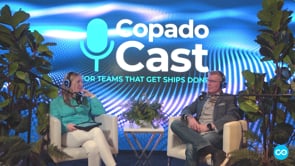
Ash Finnegan joins Kimmo, Copado’s VP of AI Research, to explore what it takes to turn AI innovation into reliable tools for Salesforce teams.
They discuss factual grounding, predictable workflows, and why human expertise remains essential to shipping with confidence.



.jpg)


Ash Finnegan joins Kimmo, Copado’s VP of AI Research, to explore what it takes to turn AI innovation into reliable tools for Salesforce teams.
They discuss factual grounding, predictable workflows, and why human expertise remains essential to shipping with confidence.
Why factual grounding and Salesforce context matter when turning AI demos into enterprise tools.
How predictable workflows and human oversight help teams ship safely with AI.
How coordinated agents expand delivery teams’ capabilities while keeping human judgment essential.
Read the full transcript or explore key moments from this episode.
Ash Finnegan [00:04]
Hi, everybody. My name is Ash Finnegan, and I'm the SVP here at Copado. One of the things I'm truly passionate about is in all of our marketing and communications that we are really responding to the needs and what our actual community and users want from the Copado platform. So we put together a new podcast. The podcast is called "Copado Cast," and "Copado Cast" is all for all the teams that get s**t done. Today, I am super excited. As we know, Copado is an AI-first company, and AI has been ingrained in everything we do across the business, which is why I am super excited to have one of my favorite people from the company, Kimmo, who is our VP of AI Research. Welcome, Kimmo.
Kimmo [00:49]
Thank you.
Ash Finnegan [00:50]
Okay, so getting started. Let's start with the title, VP of AI Research. That's not a typical title. What does that actually mean day to day? What does a Monday morning look like for Kimmo after you have your coffee, that is?
Kimmo [01:03]
Yeah, the coffee is the most important part. But Monday is actually not a very good representation of my morning because Mondays are full of sync-up meetings and everything. But Tuesday, so Tuesday morning, it usually starts so that I go through the news, what has happened in the world, and then dig into the research part of this whole AI world. Go through, essentially, many of the publications, there are quite frequently new models being released, new AI capabilities being released left and right. And one of my main thing is just to be on top of all the things that are happening in the world. And I usually start the day by just going through that with a fresh mind.
Ash Finnegan [01:58]
And it's moving so fast. Like, how do you stay on top of it? Use AI to help you?
Kimmo [02:05]
Yeah. Absolutely. But, I don't know whether there is any magic to it. It is just that I'm super curious, super curious to understand what is happening. If, honestly, if I wouldn't work for Copado, I would be still reading exactly the same stuff, and it is just something that I really enjoy doing. And of course, nowadays, it is. There is so much, and things are moving so, so, so fast that I even feel myself that I'm just lost with all these sort of updates and everything. And then just every now and then get this feeling that everything that I did yesterday is now old news. And during the night, world has moved on, and so many things have happened. And you easily get this fear of simply missing out on stuff.
Ash Finnegan [03:02]
And I want to be very clear, research isn't just what you do around AI.
Kimmo [03:06]
Absolutely.
Ash Finnegan [03:06]
Can you talk a little bit about the other sides? I want people to really understand the depth of your passion for AI.
Kimmo [03:12]
Yeah, sure. Especially for Copado, the AI or the research that we do is very much applied. So that means that part of this work is understanding what is going on in the world, what is the frontier, and how that frontier can be applied in the enterprise context that actually delivers value in real enterprise use cases to real customers. And then the other side of the coin is simply listening to the customers that we have, understanding their problems, and just trying to bridge these two worlds that, what are the things that we can take from the AI research world and apply that-
Ash Finnegan [04:02]
Yeah
Kimmo [04:02]
... in practice. Our main goal is to deliver value to real customers who are facing real enterprise problems.
Ash Finnegan [04:12]
Yeah. And the enterprise are the ones probably hit the most by the problems because-
Kimmo [04:17]
Yeah, absolutely
Ash Finnegan [04:18]
... you get something wrong in a business like that, you can bring a whole business to a standstill.
Kimmo [04:23]
Absolutely. And I mean that with all these stochastics processes, unpredictability with everything that goes on there, you start to erode the trust, and the game is over by then.
Ash Finnegan [04:36]
Yeah. No, that's definitely true. So you're described as the man, the main architect, and scientist behind Copado's AI strategy. Scientist is an interesting word for a software company. What does the research part of your job look like in practice, in the building aspect of it as well?
Kimmo [04:56]
Yeah, I think that I kind of already alluded to that. So there is very much two parts of this, that in practice, it is much about understanding that where the frontier is.
Ash Finnegan [05:07]
Yeah.
Kimmo [05:08]
Relaying and understanding how that fits into the problems that we are solving. Many of the stuff that we do are in the context of Salesforce. So how do we actually apply those things-
Ash Finnegan [05:23]
Yeah
Kimmo [05:25]
in this context? And then it's about very much hands-on experimenting, running evaluations, running benchmarks, building new stuff. Now with modern coding agents and whatnot, one of the beauties is that you can very fast get the feel that what could be actually the real customer value that all these kind of innovation could bring into our customers.
Ash Finnegan [06:00]
Yeah, and it's phenomenal. So we're very clear. Very passionate about AI. It is. You live, breathe. I know everyone would say that. That'd be the first thing everyone has always said about you. So we're very lucky to have you here at Copado.
Ash Finnegan [06:13]
So you built Copado AI from the ground up. So you didn't just research it. Take me back to the beginning. What was the hardest problem you had to solve first?
Kimmo [06:26]
So first of all, I think that Copado has been doing AI way before AI became the thing. But maybe I would take you back to the moment that ChatGPT came out and things started to be mainstream. Before AI platform, there was a Copado GPT.
Ash Finnegan [06:52]
Yeah.
Kimmo [06:53]
And Copado GPT, I would say that many of the early problems that we were facing were related to grounding the AI answers to factual content. So much of the practical things that we were working were exactly related to getting the answer accuracy-
Ash Finnegan [07:19]
Yeah
Kimmo [07:19]
... up, getting the factualness right. And these were the practical challenges very early on. And it is kind of these... I vividly remember these kind of examples where users were having these kind of trick questions that tell me how you do something with certain product or a feature which wasn't actually implemented in that product or a feature. And then without the proper grounding, it was that these models started to build all kinds of narrative around these things and we were sort of all these kind of things that we went through with evaluations and everything just to eliminate all those incorrectness that we saw. And it is still, that is one of the outstanding problems still with this, that it is not like the problem is solved.
Ash Finnegan [08:21]
Yeah.
Kimmo [08:21]
And it's a sort of struggle that we go every day. Or maybe not the struggle. But it is still a thing.
Ash Finnegan [08:27]
It's-
Kimmo [08:28]
And it continues to be a thing that we keep on improving every day.
Ash Finnegan [08:33]
Yeah, no, that's fantastic. There's a real big difference between AI that works in a demo and an AI that works in a production inside a real enterprise Salesforce org. Where do most AI systems fall apart, and how do you design around that?
Kimmo [08:49]
Yeah. Well, building a demo when you have ideal conditions, you have clean data and everything. Building a demo is entirely different ballgame than actually building a product where we are dealing with the Salesforce organizations that are decades old and the data is like metadata is all over the place, and you have a lot of legacy. So sort of- I would say that big part of the secret sauce of Copado and what we do, and in my opinion, what we do very well, is this very deep understanding of your organizations, even though your org would be all over the place and with all these kind of things. So the things that are extremely important for these production cases, that it doesn't only work when you have a fresh organization and whatnot, but then when you really hit to these real legacy, big, huge organizations with a lot of metadata and whatnot. So there is absolutely a big difference.
Ash Finnegan [10:16]
Yeah. So context is king.
Kimmo [10:18]
Context is absolutely the king. And not only that, but actually sort of finding the needle from this huge context-
Ash Finnegan [10:28]
Yeah
Kimmo [10:28]
... haystack. It is. That's a difficult problem and-
Ash Finnegan [10:34]
Yeah
Kimmo [10:34]
... and a problem that I think that we are solving very well.
Ash Finnegan [10:37]
Yeah. No, that's fantastic. And we do hear that from our customers. I think when we launched Org Discovery-
Kimmo [10:41]
Yeah
Ash Finnegan [10:41]
... it was one of the serious use cases where it really changed the game, I think, for people.
Kimmo [10:46]
Yeah, I agree.
Ash Finnegan [10:47]
On knowing where they're starting, and technical debt was obviously a hot topic, and it still is today.
Ash Finnegan [10:54]
So you focus specifically on making AI workflows predictable-
Kimmo [10:58]
Yes
Ash Finnegan [10:58]
... and guardrailed. Why predictable? Why is that the word you reach for, rather than powerful or fast?
Kimmo [11:07]
Hitting a wall powerful, fast maybe is not the ideal thing. But maybe I start with an analogy that let's say that you have a pinball game, and your ball is bouncing around the thing. And one hit to a ball can have completely unpredictable... The ball can assume completely odd trajectory after that. And all of a sudden, the ball is there in the gutter, and you don't understand what happens. So if you start to apply that thing to an enterprise context, that if your enterprise operations would be on that level, that nobody knows that you just have the ball flowing around-
Ash Finnegan [11:54]
Yeah
Kimmo [11:54]
... in this pinball game. It is not probably a strategy that many companies would value. So much of this thing is about sort of guarding this ball that it goes through around this pinball game, having some sort of magnetic trap strip there that keeps the ball on the right path. And that ultimately is there. All these sort of predictability, guardrails, repeatability are there in order to provide trust.
Ash Finnegan [12:30]
Yeah.
Kimmo [12:31]
If you cannot trust the process, then the value of the process is diminished.
Ash Finnegan [12:37]
Yeah. And I think that's a lot of where we want to look at with Copado. We're not just a generic AI tool. We are specifically for how you plan, build, test, release, and operate.
Kimmo [12:48]
Absolutely.
Ash Finnegan [12:48]
Do you think those 15 years experience that Copado had really grounds our AI and focuses our AI? We know what we do, but really the strength is in the fact that we do, do pipeline and testing and adding the AI as now embedded everywhere. So it's more around the fact that our AI is built for a very specific task.
Kimmo [13:09]
Yeah. And actually, those kind of things that you mentioned are the ingredients for building these guide rails. And with Copado, they are pretty much sort of implicit in the process. So you get that value out of the box.
Ash Finnegan [13:29]
Yeah. Because I know we often hear a lot of people say to us, "Well, I've got Claude. Do I need you?" And it's like, "No, no, you work with Claude, with Copado."
Kimmo [13:38]
Yeah.
Ash Finnegan [13:38]
Because what we do strengthens.
Kimmo [13:40]
Yes.
Ash Finnegan [13:40]
You can be there, but we're making sure that you're planning, building, testing, releasing, and operate safely and securely. Where you will from is up to you. So that's why another kind of a clear hot topic.
Ash Finnegan [13:52]
So you're building AI that operates inside delivery pipelines where the stakes are high. Production breaks, bad deployments have real consequences, and we've touched on the importance of that. How do you think about the line between what AI decides and what the human has to decide?
Kimmo [14:12]
I think that the goal post is moving almost every day. If we go back one year, the part of... Let's have a developer persona as an example. One year ago, still the part where the developer was actually producing the code was still, there was a lot of automation, there was a lot of the coding agents, the IDEs, they helped a lot in this process. But still, the human was very much in the loop of this technical process of writing the code. While if you go today, it is much so that there are many developers out there who don't touch code anymore at all. So if we think about this of one year, the change has been dramatic. It's much more dramatic. It is actually what Sam Altman was saying in his keynote there a few days ago here at Dreamforce, that the pace of progress in software engineering and software development over the last year is probably much bigger than the couple of decades before that.
Ash Finnegan [15:35]
Yeah.
Kimmo [15:36]
So the goal post there has moved on. And now, the next bottlenecks are PR reviews and all these kind of things. So it is really a moving target. And right now, I think that much of this stuff, sort of where we start to see the first real friction and first bottlenecks are in the PR process, when you are making merge requests, when you're reviewing other people's contributions and whatnot. Immediately after that, we see CI pipeline-
Ash Finnegan [16:18]
Yeah
Kimmo [16:20]
optimization and all these kind of things. Which is then actually another interesting thing that-
Ash Finnegan [16:26]
Yeah
Kimmo [16:26]
... in the Copado portfolio, the CI management and pipelines are one-
Ash Finnegan [16:34]
Yeah
Kimmo [16:34]
... big part of the puzzle as well.
Ash Finnegan [16:36]
Yeah. And it's very true. You touched on there a little bit around jobs changing and people are, like you said, probably not coding much themselves anymore. So do you see roles really dramatically changing? And there's obviously the fear of people saying, "Will I lose my job?" What's your take on roles changing, roles disappearing? What's your perspective? Because everyone kind of has a slight different variation on that answer.
Kimmo [17:04]
I think that the roles are absolutely changing, but that doesn't mean that the roles are going away. So again, going back to the software development example, that if I would go back five years and somebody would say that, "Okay, there is a computer that will write your code."
Ash Finnegan [17:22]
Yeah.
Kimmo [17:22]
My first sort of feeling would have been that, okay, the first world is going to be dramatically changed.
Ash Finnegan [17:30]
Yeah.
Kimmo [17:31]
Majority of the software developers would be out of doing that. You don't need that role anymore. Here we are today. We have more developers than ever.
Ash Finnegan [17:41]
Yeah.
Kimmo [17:41]
The amount of simply the software has gone up. And I think that actually with AI, sort of this whole automation, we are still, at least today, we are talking about sort of automation of individual tasks.
Ash Finnegan [17:58]
Yeah.
Kimmo [17:58]
So if you think about software developer, the individual tasks are these things that you're writing a particular piece of code, or you're doing this task, or you're doing that task. And many of those tasks do get automated.
Ash Finnegan [18:13]
Yeah.
Kimmo [18:13]
And progressively, more, and more, and more. And this doesn't only apply to software development. It's like all over the place. But the roles evolve just as these things do. And the thing that I kind of find always- Very motivating and inspirational is that actually all these things that we come up today, those are actually unlocking something in our thinking that we crack this problem only to understand that the next problem needs to be cracked. And we become more productive, we deliver much more, there is much more value, and yet it is this incremental thing. And to your question, the roles are definitely evolving.
Ash Finnegan [19:08]
Yeah.
Kimmo [19:09]
But at least now I cannot see these roles being eliminated. Maybe at some point. But not today, not tomorrow, and-
Ash Finnegan [19:21]
And also, I'm looking at AI is allowing for so much more things to be done.
Kimmo [19:26]
Absolutely.
Ash Finnegan [19:26]
Because it's not moving faster. If anything, the developers are still trying to now keep up with getting things out the door-
Kimmo [19:32]
Yeah
Ash Finnegan [19:32]
... and responding to what the business needs. So AI might help them just keep up with the sheer volume of AI bringing new things in. So they're just constantly, "I've got to ship more." So yeah, like I said, it creates a problem, but also might solve the problem that they're needed more because there's so much more that needs to be done. But yeah, time will tell. But I agree with you.
Kimmo [19:53]
Time will tell, yeah.
Ash Finnegan [19:54]
I think we're very aligned on that thinking.
Ash Finnegan [19:57]
So where we're at now is, so we did research, as you know, with Salesforce Ben. We had our State of AI Salesforce Delivery Report.
Kimmo [20:05]
Yeah.
Ash Finnegan [20:05]
And as the research we launched this week says, 37% of practitioners want explainability more than anything else. They want to understand the decision, not just see the output. As the person building these systems, how do you think about that?
Kimmo [20:21]
It is a critical thing, something that if you cannot explain, it is very hard to understand that. And if you cannot understand that, how can you trust that?
Ash Finnegan [20:31]
Yeah.
Kimmo [20:31]
So it is pretty much all these explainability, understanding, and trust, they are a big part of the overall puzzle. But I wouldn't say that the explainability, to me, is not enough, something that you do after the fact. We can easily find explanation for things that we have done. But even more important to me is understanding and having trust to the process before you actually initiate the process. And that actually goes back to this predictability, repeatability thing that before you start building your user story or before there is a failure in your system, you actually need to understand and be able to pretty accurately predict that what will come out of the factory when the thing is done.
Ash Finnegan [21:37]
Yeah. So I guess it's also about, I guess the best advice is don't get lazy and let AI do your work.
Kimmo [21:43]
Absolutely.
Ash Finnegan [21:43]
Work with it, and let it be a true partner in crime with you.
Kimmo [21:47]
Absolutely. And that's, I mean when you look at the social media and whatnot, you hear this AI slop here and there.
Ash Finnegan [21:54]
Yeah.
Kimmo [21:54]
I think that that is actually a discipline problem-
Ash Finnegan [21:57]
Yeah
Kimmo [21:57]
... more than AI problem. I mean that if you give these ambiguous inputs to the AI, you never review that, you never try to understand that, then how can you actually claim that it is a process failure or AI failure-
Ash Finnegan [22:16]
Yeah
Kimmo [22:16]
... that you're in this situation. So it is just a discipline thing to me.
Ash Finnegan [22:23]
So agents are really becoming your teammates. You've got to get to know them. You've got to know how they complement what you're doing and how. Because I think anytime, I got to know where you fit and I fit to get the job done.
Kimmo [22:34]
Yeah.
Ash Finnegan [22:34]
And I guess people cannot switch off. Because I know I find myself, when I use AI from a marketing perspective, I have more arguments with it than anything. I'm constantly going, "But that's not true. But what about this, and what about that?" And then the AI does come back and go, "Yeah, that's all right."
Kimmo [22:48]
Think about your human teammate or so that you would give these hand-wavy instructions, and then you're being completely upset of your teammate-
Ash Finnegan [23:02]
Yeah
Kimmo [23:02]
... being completely confused about your instructions and just trying their best to fulfill whatever-
Ash Finnegan [23:08]
Yeah
Kimmo [23:08]
... thought you wanted to have there. It is an absurd situation. And yet, here we are doing that with computers.
Ash Finnegan [23:16]
Yeah. And I think that for me, in my mindset, I'm like, don't fear it. See it as someone joining the team-
Kimmo [23:24]
Yeah
Ash Finnegan [23:24]
... that's helping you get your job done.
Kimmo [23:25]
Absolutely.
Ash Finnegan [23:26]
And keeping that human in the loop is really, really important.
Kimmo [23:29]
Yeah.
Ash Finnegan [23:31]
So yeah, again, time will tell, but I think the more people embrace it and understand it, I think then that's the security that they're probably looking for.
Ash Finnegan [23:41]
So section four is all around where AI engineering is going. So this is something I know you're also very deeply passionate about. So Agentia, we launched Agentia, is built around agents that coordinate across the full delivery lifecycle. Agents in the workflow.
Kimmo [23:57]
Mm.
Ash Finnegan [23:59]
Plan, build, test, release, and operate. What was the hardest part of the architecture to get it right?
Kimmo [24:08]
Actually, when I think about it, I'm not necessarily sure that technical and architectural things were the things that were most difficult, and I don't still think that is difficult. I think that we have these agent, well, I would call them domain agents. There is some sort of domain where they have expertise on. And they very nicely implement this whole DevOps end-to-end. The conceptual problems are there that in many cases, for example, if we take testing as an example. Testing doesn't stand alone. It requires input from here and there and whatnot. So it is like, as an example, it is very much integrated into your planning. So even though the planning agent would be responsible of working with your user stories, the test agent actually requires many of those assets that are built by other agents. So then actually, to me, the biggest problem is to understand how these domain agents operate together. And there, maybe the technical things that I think that are even more important right now to solve this is how to make this layer a bit more, I would say, transparent in a way that for user, there wouldn't be
Kimmo [25:48]
this cognitive exercise to figure out that I'm doing planning, which means that I need to select a plan agent, but this would be more automated actually in the-
Ash Finnegan [26:00]
Yeah
Kimmo [26:00]
... process. So therefore, right now we are on the R&D side, focusing more on this, I would say, omnipotent agent that can actually assume a role of all these agents, depending on the thing that you do.
Ash Finnegan [26:17]
Yeah. So it's all around the job that needs to be done.
Kimmo [26:21]
Exactly.
Ash Finnegan [26:21]
And then what I need to do. It's almost like building a new workforce as well that's going to work with your team because you've got to understand what they're going to do.
Kimmo [26:29]
Yeah.
Ash Finnegan [26:29]
What's the job to be done?
Kimmo [26:30]
Exactly.
Ash Finnegan [26:30]
So I was talking earlier on Salesforce, Ben, and we were having this conversation. I was like, "God, I remember Ted spoke to me." I'd only started with the company. We were big in our chat, like a part of GBT stage. And we are really at first doing it, and nobody else was really doing it around. And I remember I started with the company, so my first reaction was, "Okay, what's the problem we solve?" Which is plan, build, test, release. And then I was like, "What are the jobs to be done?" And I was listing all the jobs underneath this, and that was for... And then I'm like, "Okay, where does the path, where are we strong and weak in all of the jobs that a human needs to do?" And it was funny because then separately I had a call with Ted, and he's like, "AI's coming, and these agents are going to be working with you, doing the job." And that was the first time I heard it, because Agentforce wasn't around or anything at the time. And I remember just sitting there kind of going, "Oh, wow." But then because I had that vision chart of all the jobs to be done, and then where
Ash Finnegan [27:21]
a human would fit and where AI would fit and the... But that's kind of what you're saying. We need to almost train these on what needs to happen, when it needs to happen, and what skills it takes to happen, and where they all connect with each other. That's a lot.
Kimmo [27:36]
It is. But in the end, it is not like- That load shouldn't be on the end user. So end users shouldn't actually-
Ash Finnegan [27:45]
Yeah
Kimmo [27:46]
... care much about these things. So these are technical R&D problems that-
Ash Finnegan [27:53]
Yeah
Kimmo [27:53]
... needs to be solved and for user it is just that, "Dear agent, I have a problem."
Ash Finnegan [28:02]
Yeah. So my next question then is, because normally if I look at plan, build, test, release, operate, I could have a lot of different personas. So I might have the business analyst is really in depth with the planning, the developer is in the coding, you have a QA team. Do you see roles blending then? Because like you're saying, I remember I was showing a developer and we were going through all the different agents, and he was like, "Oh, because you put plan test there, I might actually think more seriously about testing."
Kimmo [28:29]
Absolutely.
Ash Finnegan [28:30]
And he goes, "But I normally shied away from it because normally that's over there, but because you're now making it easy for me." So do you think the agents will help people expand their skillset?
Kimmo [28:42]
Absolutely. And to cooperate more tightly because for UX people-
Ash Finnegan [28:53]
Yeah
Kimmo [28:53]
... it allows them to actually build working proof of concepts that are entirely interactive and actually implement-
Ash Finnegan [29:04]
Yeah
Kimmo [29:04]
... a sort of shallow business logic behind it. While for developers they can quickly build these prototypes and everything and have-
Ash Finnegan [29:14]
Yeah
Kimmo [29:14]
... the dialogue-
Ash Finnegan [29:16]
Yeah
Kimmo [29:16]
... between various stakeholders. So definitely it will lower down these barriers that what you can do, what is expected from you.
Ash Finnegan [29:26]
Yeah.
Kimmo [29:27]
That may be also sort of flip side of it that now it's sort of expected from everybody that you need to be such a generalist-
Ash Finnegan [29:36]
Yeah
Kimmo [29:36]
... that you can go here and there and everywhere.
Ash Finnegan [29:39]
And it's going to cause an interesting dynamic because one thing I'm finding is, because AI, they make people feel they can do anything.
Kimmo [29:46]
Yeah.
Ash Finnegan [29:47]
So I see people even trying to do marketing things.
Kimmo [29:49]
Sure.
Ash Finnegan [29:49]
And I'm looking at them going, "But no, you're missing some of the fundamental practices around whether it's who you can message or how you..." So there's fundamental things you learn as a marketeer-
Kimmo [29:59]
Mm-hmm
Ash Finnegan [29:59]
... that somebody who's not a marketeer thinks, "Oh, now I can build a website overnight," or, "I can now launch messaging." And you realize that there is an art to doing that.
Kimmo [30:07]
Yeah. So there is a difference. This is the thing. There is a difference between vibe coding and vibe engineering. And it is the same thing, that there is a difference between vibe marketing and, yeah, whatever the thing is that where I still think that human expertise provides so much value that we can actually understand and look behind the scenes that does this actually-
Ash Finnegan [30:39]
Yeah
Kimmo [30:41]
thing that came out, that whether it is just this sort of-
Ash Finnegan [30:44]
Yeah
Kimmo [30:44]
... shallow AI slop or whether there is more to it.
Ash Finnegan [30:48]
Has depth.
Kimmo [30:48]
Yeah.
Ash Finnegan [30:49]
Yeah. So that's where I guess the passion of the human and it is that teammate of understanding what the agent is doing. You do need to have a level of expertise in the topic.
Kimmo [30:58]
Absolutely.
Ash Finnegan [30:59]
I think, yeah.
Kimmo [31:00]
But that also depends on what you're doing. There are many scenarios where you don't actually need this. It is just okay that you just do something and just sort of trust it. Yeah. That you just do something and you get something out and maybe you throw away it. That is just fine. But in the context of real products, this just doesn't cut it. You need to understand that this layer of updates that I do is not going to break anything. You know the, you keep the delivery pipeline-
Ash Finnegan [31:44]
Yeah
Kimmo [31:44]
... green all the time.
Ash Finnegan [31:45]
Yeah.
Kimmo [31:45]
That is a different ballgame than just vibe coding something and easily seeing something new.
Ash Finnegan [31:53]
So you need the art and skill. So one thing I do know, I know we're talking for some time now, is we're going to make this a continuous series because you're developing so much for us. You're so passionate about this. This series, podcast series, is all about the community and letting them also know what we're doing, why we're doing what we're doing with AI, how to embrace it, how to use it, and how to run with it. So firstly, I want to say a massive thank you. It's been fantastic speaking to you. I could sit here all day. This is probably one of the podcasts that could go on for hours, no doubt. But massive thank you, Kimmo. I do, as I said, we will have probably a monthly kind of cadence with you where we'll take on the latest topic around AI or what we're just about to launch and really allow the community to engage with you and ask questions. If you ever have an opinion or want a voice to be able to talk about your experience of developing on Salesforce, any business application, or using Copado, I would love to hear from you. If you reach out to myself or the team, and we can find us at
Ash Finnegan [32:56]
copadocast@copado.com. We would love to hear from you and welcome you to take a seat here alongside one of our many hosts who could talk about your experience and help you help other developers in the community with your experience. So again, if you want to take part, please email copadocast@copado.com. I want to say thank you. It's been a real pleasure as always, Kimmo. And yeah, I'm super excited for our next guest.
Kimmo [33:24]
Absolutely.
Ash Finnegan [33:24]
Thank you. Thank you, Kimmo.
Kimmo [33:26]
Thank you.
%20(1).png)
.jpg)
Be the first to know about new episodes, guest announcements, and CopadoCast updates.


.svg)