.svg)





%201.svg)
%201.svg)
%201.svg)


.svg)



.avif)
.avif)
.png)



.avif)



%20Data%20to%20Me_BLOG_1080x600.avif)


.avif)


.avif)


.avif)


.avif)


Copado AI
DevOps teams are under more pressure than ever to move fast, stay compliant, and deliver with confidence. Here, generative AI in DevOps steps in, not as a replacement for human expertise, but as a force multiplier that removes friction and sharpens decision-making.
When applied thoughtfully, artificial intelligence helps teams turn complexity into clarity and accelerate delivery. This article explores how generative AI is reshaping DevOps practices and how teams can use it to move from idea to impact with confidence.
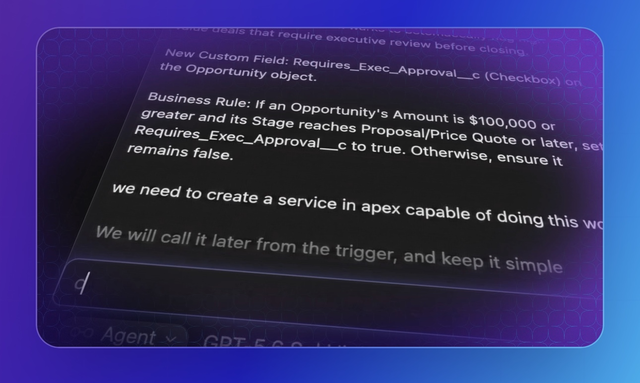
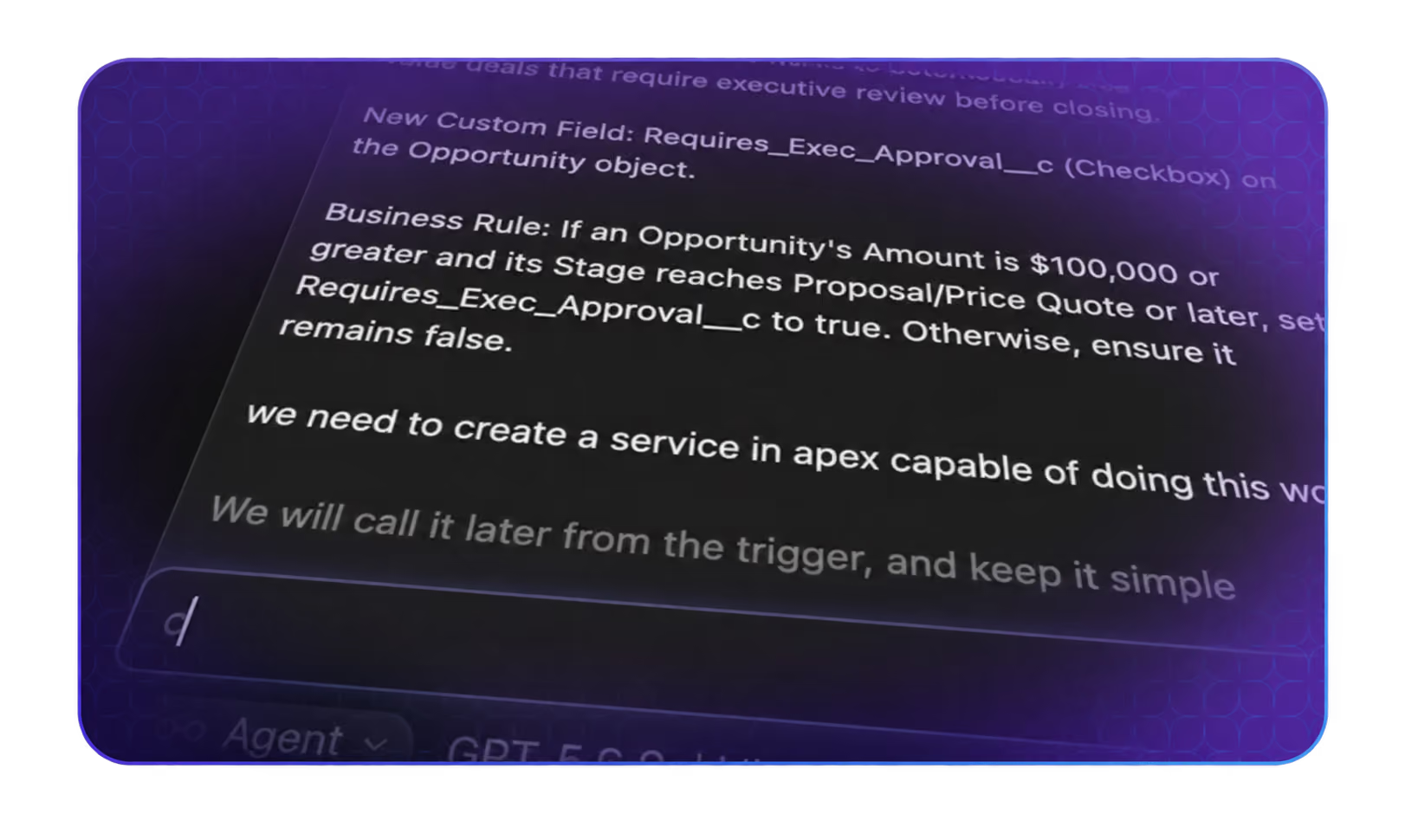
At its core, generative AI in DevOps uses model-driven intelligence to create, recommend, and improve outputs across the software development lifecycle. Instead of relying solely on manual scripting, static rules, or tribal knowledge, teams can use AI models to generate code, tests, documentation, and deployment guidance in real time.
Think of it less as automation and more as amplification. Generative AI doesn’t replace your expertise; it multiplies it. It learns from patterns across environments, pipelines, and past releases, then helps you move forward with more clarity and fewer unknowns.
For DevOps teams, that means AI tools can assist with:
When using AI in DevOps, the goal isn’t to add another shiny tool. It’s to remove friction from everyday work so teams can focus on delivering value with confidence. And when AI is thoughtfully embedded into the DevOps flow, it becomes a natural extension of how teams already work. That’s where real impact starts to show.
DevOps teams don’t struggle because they lack skill. They struggle because too much time is spent on work that should be easier by now. Manual scripts that break silently, troubleshooting sessions that feel like déjà vu, and documentation that’s outdated the moment it’s published—do these sound familiar?
These challenges slow delivery and quietly drain confidence. And they make it harder to answer a question many leaders are asking right now: how can a DevOps team take advantage of AI without adding risk or complexity? This is where generative AI for DevOps changes the equation.
Instead of starting from scratch every time, AI can reason over existing data and generate meaningful output in seconds. It accelerates development that usually takes hours, while helping teams avoid the mistakes they’ve already made before. Here’s what that efficiency looks like in practice:
The result is both speed and steadiness. Teams move faster because they feel more in control. Releases stop feeling like high-stakes events and start feeling like repeatable wins.
That’s the real promise of generative AI in DevOps: not chaos, not shortcuts, but confidence at scale.
Generative AI shows up in DevOps in very practical, hands-on ways. Not as abstract AI initiatives, but as daily support for the work teams already do. When implemented thoughtfully, these capabilities fit directly into CI/CD workflows and delivery pipelines, helping teams make better decisions faster.
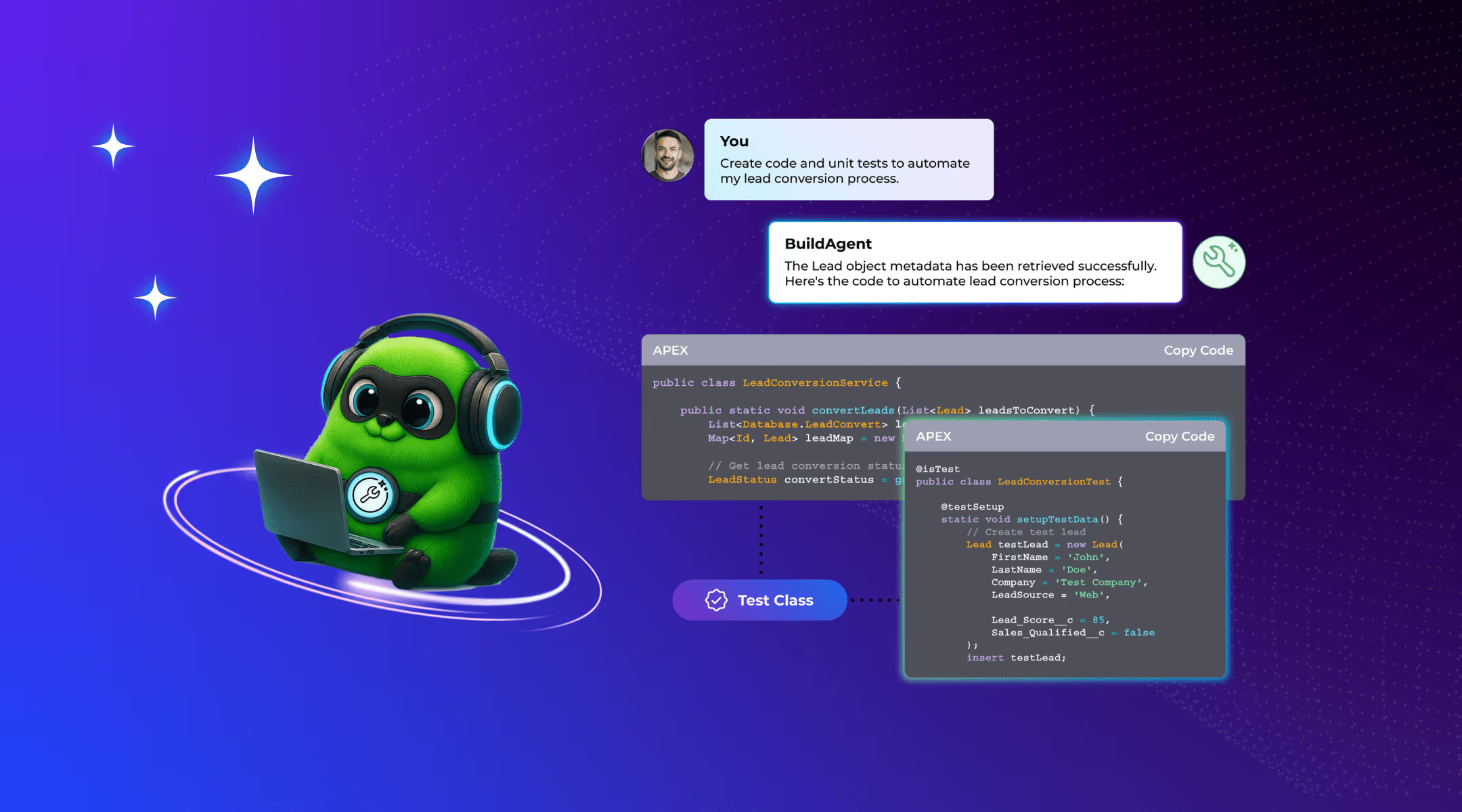
Writing deployment scripts, configuration files, and test cases is necessary work, but it’s rarely the work that teams want to spend most of their time on. Generative AI can step in here as a capable co-pilot. By learning from existing repositories, metadata, and successful releases, AI can generate code and scripts that align with established standards and best practices. That means:
Instead of staring at a blank file, teams start with a strong foundation and refine from there. The heavy lifting is handled, while engineers stay firmly in control of the final outcome.
When something breaks, time matters. But traditional troubleshooting often relies on gut instinct, scattered logs, and whoever happens to remember a similar issue from six months ago. Generative AI changes that dynamic.
By analyzing system behavior, error patterns, and historical data, AI can quickly suggest likely causes and potential fixes. It doesn’t just flag that something went wrong; it helps explain why. For DevOps teams, this leads to:
Every issue becomes an opportunity to reduce friction the next time around.
Documentation has a notorious reputation problem:. It’s often outdated, incomplete, or ignored because keeping it current feels like a losing battle.
With generative AI, knowledge stays aligned with reality, not memory. Instead of treating documentation as a separate task, AI can continuously generate and update runbooks, release notes, and workflow explanations as changes happen.
This is especially powerful for onboarding. New team members don’t have to rely on word-of-mouth or tribal knowledge: they get clear, current guidance from day one. And over time, that shared understanding becomes a force multiplier for the entire organization.
Generative AI only delivers value when it’s applied with intention. Left unchecked, it can introduce noise, inconsistency, or risk. That’s why the real question isn’t whether to adopt AI; it’s how to do it in a way that builds trust, control, and confidence.
Copado brings generative AI directly into the DevOps experience teams already know: Salesforce-native, governed, and built for enterprise scale. Instead of forcing teams to stitch together disconnected tools, Copado integrates AI into planning, building, testing, and releasing, so intelligence flows naturally across the lifecycle.
At the heart of this approach is AI as amplification, not automation for automation’s sake. Copado’s AI DevOps solutions are designed to learn from your org, your metadata, and your delivery history to help you make smarter decisions with less effort.
Here’s how Copado makes generative AI practical and powerful:
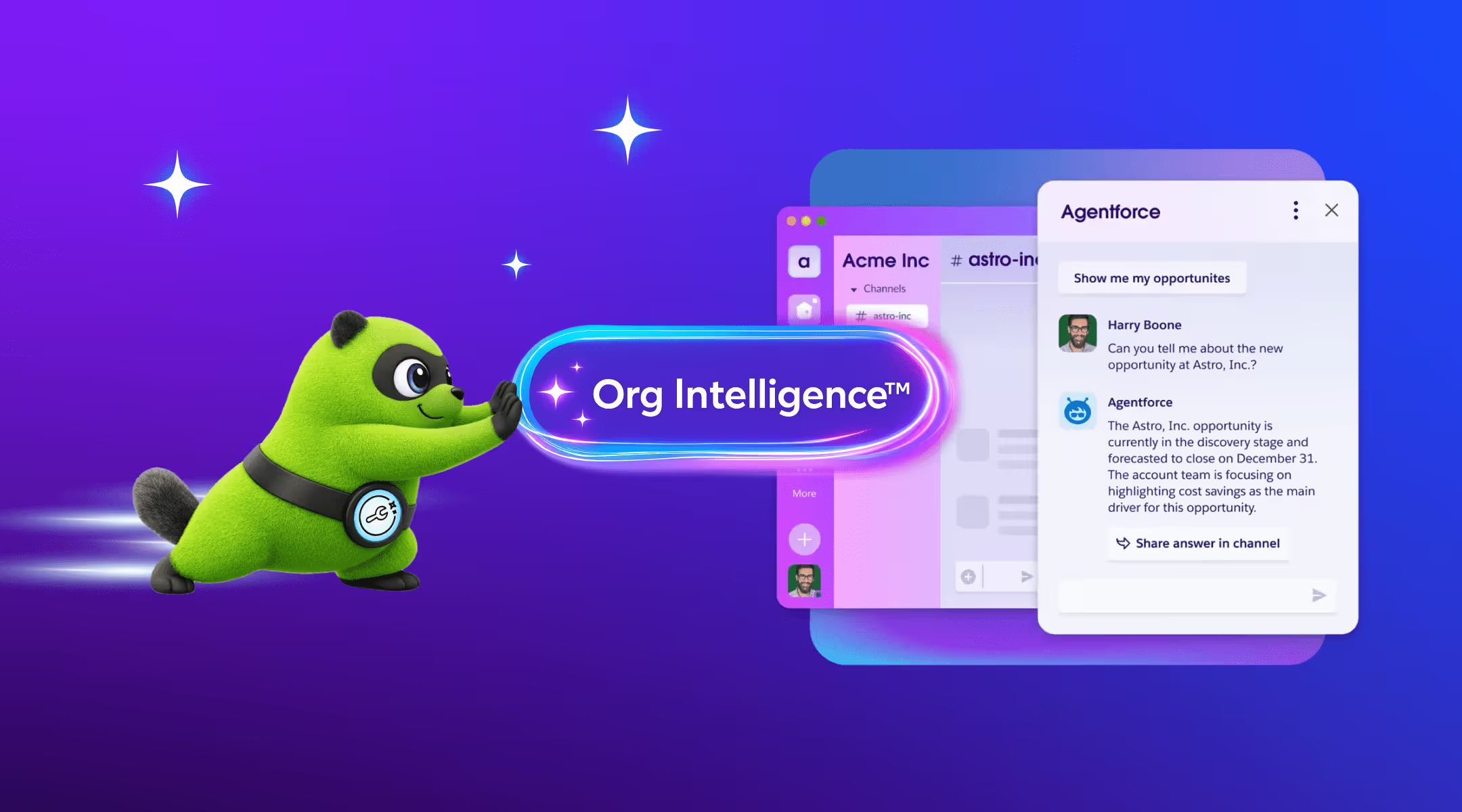
For teams wondering how a DevOps team takes advantage of AI without increasing risk, Copado provides a clear answer: Start where you work, stay in control, and let intelligence do the heavy lifting. And with Agentforce solutions, Copado extends that intelligence even further, bringing AI-powered agents into the DevOps flow to guide actions, reduce friction, and help teams move from insight to execution faster.
The impact of generative AI becomes clearest when you see it at work, solving real problems for real teams. Here’s how DevOps organizations are putting generative AI for DevOps into action with Copado.
Many teams struggle with the same cycle: last-minute fixes, manual checks, and late nights before a release. Generative AI helps break that pattern.
By generating deployment scripts, validating configurations, and surfacing potential risks earlier in the pipeline, teams can move faster without gambling on quality. Releases become predictable, not panic-driven. The results are faster time-to-market and the confidence that comes with knowing what you’re shipping will work.
As organizations scale, consistency becomes harder to maintain. Different teams, different standards, and different levels of experience all add up. Generative AI helps normalize best practices across pipelines by learning what “good” looks like in your environment and reinforcing it automatically. Scripts, tests, and processes stay aligned, even as teams grow.
This isn’t about enforcing rigid rules. It’s about creating shared clarity, so everyone moves forward together.
Onboarding can be one of the quietest productivity drains in DevOps. New hires often spend weeks just figuring out how things work.
With continuous documentation and AI-generated guidance, new team members can get up to speed faster, without pulling senior engineers away from their work. Runbooks stay current. Workflows make sense. Context is always available. There will be less friction, faster contribution, and a stronger sense of ownership from day one.
Generative AI is changing how DevOps teams build, test, and release software, but the technology itself is only part of the story. What really matters is how that intelligence is applied. When using AI in DevOps thoughtfully, teams move with more confidence. Complexity becomes manageable. Risk becomes visible. And delivery becomes something teams can trust, not fear.
Copado exists to make that future real. By embedding generative AI into a Salesforce-native, enterprise-ready platform, Copado helps teams scale automation, reliability, and impact without sacrificing control. With AI DevOps solutions and Agentforce solutions, intelligence becomes a natural part of the delivery lifecycle, not an add-on or experiment.
From idea to impact, the future is yours to build. And with Copado as the multiplier, you don’t just keep up. You lead.
Release Faster, Eliminate Risk, and Enjoy Your Work.
Try Copado Devops.
Explore our DevOps resource library. Level up your Salesforce DevOps skills today.


.avif)


.svg)