.svg)


%201.svg)
%201.svg)
%201.svg)



.svg)











.avif)
.avif)
.png)






.avif)






%20Data%20to%20Me_BLOG_1080x600.avif)


.avif)


.avif)


.avif)


.avif)


CI/CD
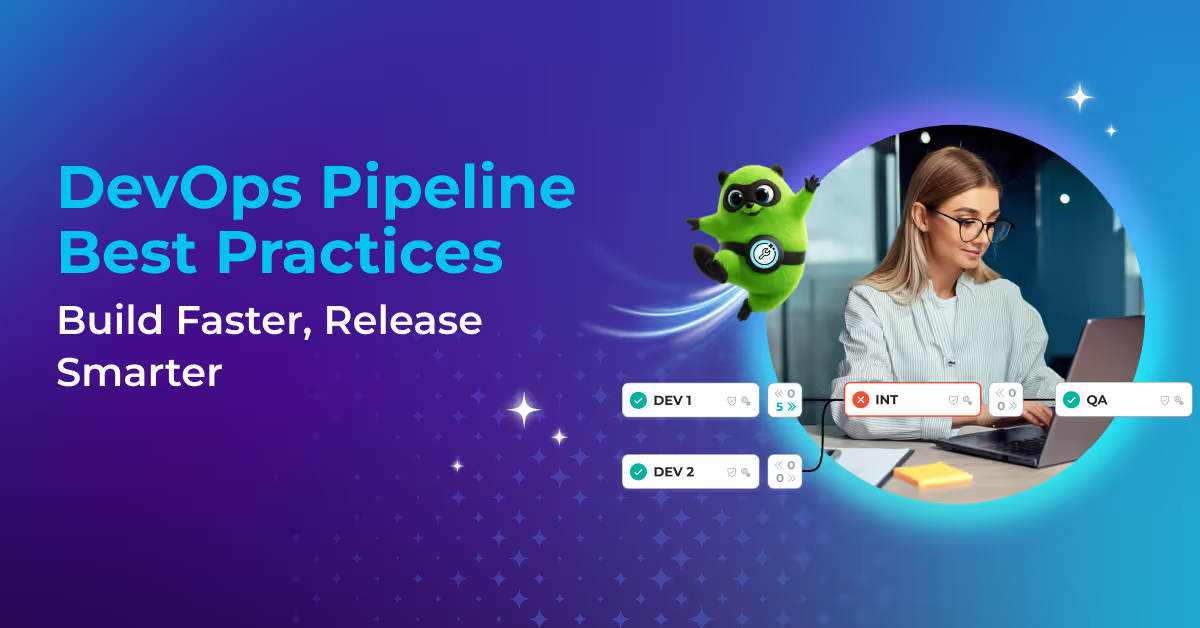
Release day shouldn’t feel like a high-stakes gamble. Yet for many DevOps teams, it still does, with last-minute fixes, crossed fingers, and that nagging fear that something, somewhere, will break. The truth is, modern software delivery doesn’t fail because teams lack talent. It fails because pipelines aren’t built for confidence.
When done right, your DevOps pipeline becomes more than a delivery mechanism; it becomes a source of momentum. A way to turn ideas into impact without chaos, rework, or sleepless nights. Let’s break down what DevOps pipeline best practices really are, why they matter, and how you can build a workflow for your team.
At its core, a DevOps pipeline is the structured path your code follows from idea to production. It orchestrates how changes are integrated, tested, validated, and deployed across environments. Think of it like an assembly line for innovation. Every stage has a purpose:
A well-designed pipeline brings DevOps practices and principles to life. It connects software development and operations into a single, shared flow, replacing handoffs and heroics with clarity and control. And when pipelines are Salesforce-native like with Copado, that flow lives right where your development and operations teams already work.
Here’s the uncomfortable truth: Most delivery lifecycle issues aren’t caused by bad infrastructure as code; they’re caused by inconsistent processes.
Manual steps. One-off fixes. “It worked in my environment.” These cracks in the foundation of DevOps principles slow teams down, reduce observability, and introduce real risk especially as organizations scale. Without clear metrics and DevOps best practices, pipelines become fragile. Releases take longer, and bugs slip through.
This is also where confusion around DevOps vs. Agile often shows up. Agile helps teams plan and iterate quickly, fostering continuous improvement. DevOps ensures those provisions and iterations actually reach users safely and repeatedly from a secure and optimized repository. One without the other leaves value on the table.
And when security is bolted on at the end instead of built in from the start, teams start debating DevSecOps vs. DevOps. But, modern pipelines need reliability on both speed and security. Best practices make that balance possible.
In short, pipeline best practices matter because they replace uncertainty with trust, and trust is what lets teams move fast through the development process.
There’s no one-size-fits-all pipeline for the development lifecycle. But high-performing teams tend to follow a shared set of fundamentals for exceptional software quality. These organizational best practices don’t add complexity; they remove it. They create a delivery rhythm that scales with your ambition.
Manual processes are the enemy of momentum. Every copy-paste step, every checklist-driven deployment, every “don’t forget to…” is an opportunity for error and stress.
End-to-end automation is the backbone of strong devops pipeline best practices.
Continuous integration (CI) ensures code changes are merged and validated early. Continuous delivery (CD) makes sure those changes move through environments in a repeatable, predictable way.
Automation doesn’t just make releases faster. It makes them calmer. When workflows are automated:
Intelligent automation matters. Platforms like Copado go beyond basic CI/CD by learning from your org’s history. It surfaces risk before it becomes a problem and helps teams act with confidence, not guesswork. Automation becomes a multiplier, not just a time-saver for DevOps success.
Speed without quality security measures is just chaos on fast-forward. Testing gates are what keep your pipeline honest. They ensure every change earns its way forward, meeting clear standards before it reaches the next stage. And no, this isn’t about slowing teams down but avoiding painful rollbacks later. Strong pipelines layer testing intelligently:
This is where the conversation around DevSecOps vs. DevOps often gets misframed. Security isn’t a separate motion, but a shared responsibility. The best pipelines embed security into the flow, so teams don’t have to choose between speed and safety.
When testing is automated and consistent, quality stops being subjective. Everyone knows what “ready” looks like. And that shared clarity builds trust across teams, from developers to stakeholders.
If every environment is a snowflake, every deployment is a gamble. Differences between development, testing, and production environments create false confidence and last-minute surprises. Standardizing environments and deployment patterns changes the game:
This consistency is especially critical for Salesforce teams operating at scale. When deployments are standardized and native to the platform, governance and visibility are built in. The payoff is simple but powerful: fewer defects, smoother releases, and a pipeline your team actually trusts.
Best practices set the foundation. Copado helps you scale them without adding friction.
As the only 100% Salesforce-native intelligent DevOps Platform, Copado was built to work with the platform you already trust, not around it. That native advantage matters. It means fewer integrations to manage, less context switching, and more confidence at every stage of delivery.
Copado simplifies pipeline design by bringing planning, development, testing, and release management into a single, unified flow. Instead of juggling disconnected tools, your entire pipeline lives inside Salesforce. That clarity alone removes a huge source of delivery drag in DevOps culture.
Beyond standard CI/CD, Copado’s AI-powered capabilities—rooted in Org Intelligence™—learn from your metadata, deployment history, and past outcomes. Risk isn’t just detected; it’s predicted. This DevOps transformation enables teams to act earlier, avoid repeat mistakes, and move forward with confidence.
Copado enforces policies, approvals, and compliance checks automatically, making it easier to align with enterprise and regulated-industry requirements. You get speed with control, not speed at the expense of trust.
Developers, admins, release managers, and business stakeholders all see the same picture. No more siloed updates or last-minute surprises. Everyone moves together, from idea to impact. This is DevOps that feels human. Powerful, yes, but also calm, predictable, and reliable.
DevOps pipeline best practices sound great on paper. What really matters is how they show up in the real world. Here’s what organizations achieve when they pair strong practices with AI DevOps solutions via Copado.
Large Salesforce teams often struggle with release bottlenecks. Too many contributors. Too many dependencies. Too much manual coordination. By standardizing pipelines and automating CI/CD with Copado, teams cut release cycles from weeks to days (sometimes hours!) without increasing risk. Teams stop fearing release day and start treating it like business as usual.
Organizations adopting comprehensive testing gates and environment consistency see dramatic drops in post-release issues. Automated testing and deployment patterns catch problems early, when they’re cheaper and easier to fix.
For teams in finance, healthcare, and the public sector, compliance isn’t optional. Copado’s native audit trails, policy enforcement, and security controls make it easier to meet regulatory requirements without slowing delivery. This is where the debate around DevOps vs. DevSecOps fades away, because security is already part of the pipeline, not a separate hurdle at the end.
As organizations explore agent-based automation and AI-assisted development, pipelines must evolve. Copado supports Agentforce solutions by providing the delivery backbone that makes intelligent agents practical at scale. AI-driven insights guide decisions, while automated pipelines ensure those decisions move safely into production. Innovation accelerates, but control stays firmly in place.
When you follow proven DevOps best practices, you create space for creativity instead of cleanup. And when automation, testing, consistency, and governance are powered by a Salesforce-native, AI-driven platform like Copado, something bigger happens. Delivery stops being a source of stress and starts becoming a competitive advantage.
Copado exists to make your Agile and DevOps journey easier. To help you move faster without losing control. To replace release-day anxiety with confidence. And to remind you that you’re the hero of this story; Copado just multiplies your impact.
From idea to impact, the future is yours to build.
Release Faster, Eliminate Risk, and Enjoy Your Work.
Try Copado Devops.
Explore our DevOps resource library. Level up your Salesforce DevOps skills today.


.avif)


.svg)