


.svg)


%201.svg)
%201.svg)
%201.svg)



.svg)


.avif)


.avif)




.avif)


.avif)
.avif)
.png)




.avif)


.avif)


.avif)


Copado AI

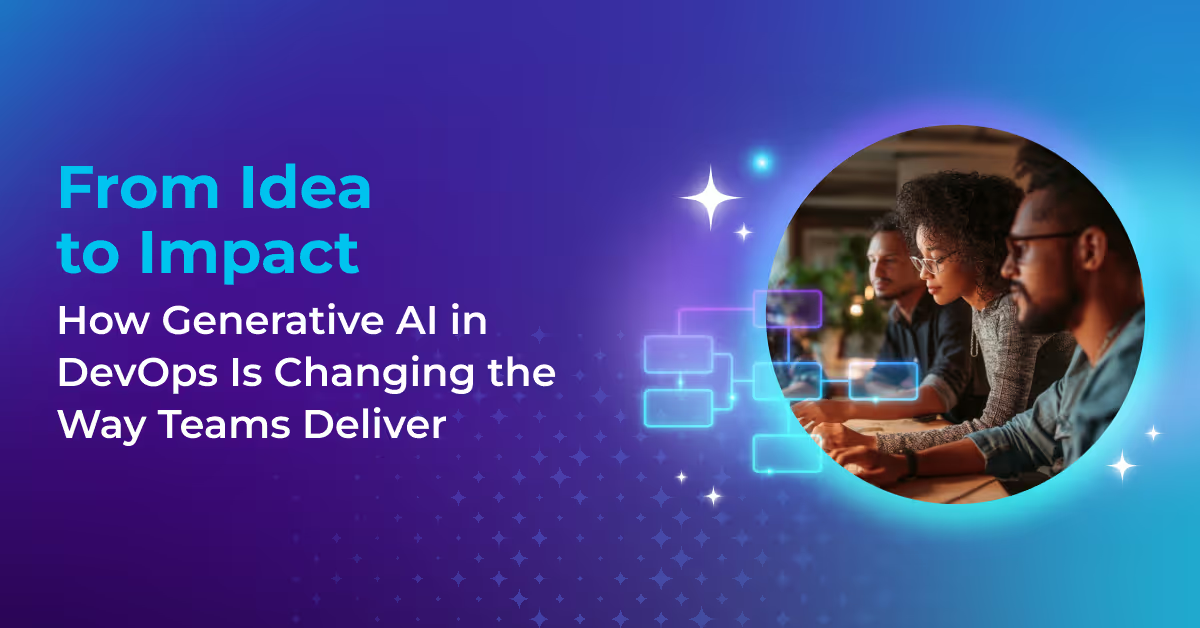
DevOps wasn’t meant to feel like a constant fire drill, but for many teams, it does. More releases, more complexity, and less room for error can quickly drain system performance momentum. Here, artificial intelligence steps in as a steady hand that helps you see risks sooner, automate the busywork, and ship with confidence. When used the right way, AI doesn’t just help DevOps teams; it supports them in moving from idea to impact, faster and with far less stress.
Artificial intelligence has quietly shifted the DevOps conversation from keeping up to getting ahead. Today, DevOps teams can take advantage of AI systems to smooth out workflows, raise release quality, and cut through the noise that slows delivery down. Instead of reacting to issues after the fact, AI helps DevOps teams spot risk earlier, automate repetitive work, monitor systems, and make smarter decisions with less effort.
When teams start using AI in DevOps practices, the goal isn’t to replace human judgment. It’s to amplify it. AI can also take on the heavy lifting of pattern recognition, monitoring, and prediction, so you can focus on building, shipping, and confident software delivery.
Modern DevOps environments are busy. Pipelines are more complex. Releases happen faster. And expectations keep rising. Many teams still rely on reactive troubleshooting of waiting for failures, digging through logs, and scrambling on release day.
But artificial intelligence is a proactive player in DevOps. It watches what humans can’t easily track at scale, flags risks before they escalate, and automates decisions that used to drain time and energy. For teams wondering how can a DevOps team take advantage of AI, the answer is simple: by turning chaos into clarity. Here, you get fewer surprises, faster feedback, and a lot less release-day stress.
AI is a set of practical tools that fit naturally into DevOps workflows. Here’s how teams are taking advantage of artificial intelligence and putting it to work today.
Pipelines break when standards drift, and configurations change unnoticed. AI helps prevent that. By learning from your environment, tools like AI can help enforce best practices, catch misconfigurations early, and ensure governance stays intact without slowing teams down.
This is especially critical in regulated industries, where compliance isn’t optional. Instead of manual checks and last-minute audits, AI can assist with keeping guardrails in place automatically, so speed and control go hand in hand while using machine learning..
When something goes wrong, time matters. AI accelerates incident response by analyzing logs, correlating events, and pinpointing likely root causes in seconds, not hours.
Teams can use AI-assisted insights to understand what happened, why it happened, and what to fix, without combing through endless data. The payoff is clear: shorter outages, faster resolutions, and more confident teams.
Great DevOps teams improve continuously. Let your team take advantage of artificial intelligence by letting it evaluate pipeline performance over time and recommend ways to optimize.
From identifying bottlenecks to suggesting smarter release timing, implementing AI in DevOps turns historical data into forward-looking guidance. It’s a practical example of generative AI for DevOps that helps teams learn from every release and get better with each one. It encourages your team to focus more on critical thinking and product improvement.
Integrating AI into DevOps works best when it’s aligned with real workflows, not bolted on as an afterthought.As a Salesforce-native platform, Copado embeds AI tools directly into the DevOps lifecycle. Through its AI DevOps solutions, Copado helps teams assess their current processes, integrate AI responsibly, and redesign workflows to reduce friction and complexity.
Copado also brings hands-on guidance. From readiness assessments to enablement and ongoing optimization, teams don’t have to figure it out alone. The result is integration of AI that actually delivers value—faster releases, fewer errors, and stronger confidence across the organization.
For teams building with Agentforce solutions, Copado ensures AI-driven development and delivery stay aligned, governed, and scalable from idea to impact.
We see it every day. Teams overwhelmed by manual checks and reactive firefighting start using AI in DevOps, and things click.
One team reduced release errors by catching configuration issues before deployment. Another cut incident resolution time in half by using AI-driven insights to guide troubleshooting. Others increased deployment frequency without increasing risk, thanks to predictive release planning.
In each case, using AI to automate tasks didn’t replace the team. It made them unstoppable.
Machine learning is no longer a future concept for software development; it’s a practical advantage. When used thoughtfully, implementing AI helps teams move faster, release with confidence, and turn complexity into opportunity.
Copado exists to make that journey simpler. By combining Salesforce-native DevOps with AI amplification, Copado empowers you to spend less time managing chaos and more time delivering impact.
You’re already doing the hard work. AI models just help you do it better. And with Copado as the multiplier, the future is truly yours to build.
ResearchGate. “AI-Powered Release Management for Continuous Deployment.” https://www.researchgate.net/publication/388793040_AI-Powered_Release_Management_for_Continuous_Deployment.
より速くリリースし、リスクを排除し、仕事を楽しんでください。
Try Copado Devops.
Explore our DevOps resource library. Level up your Salesforce DevOps skills today.


.avif)


.svg)

