Articles
6/5/2026
10 minutes

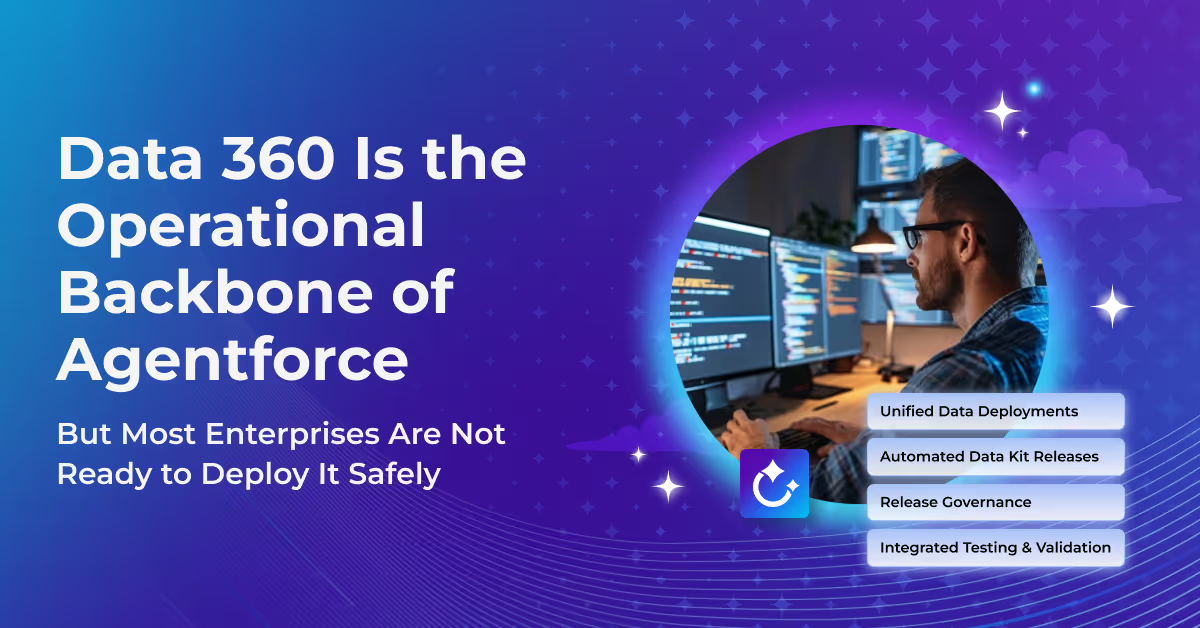
Data 360 Is the Operational Backbone of Agentforce — But Most Enterprises Are Not Ready to Deploy It Safely

Written by
Steve Simpson
Table of contents

Enterprise AI conversations are rapidly shifting from experimentation to execution.

Boards want measurable returns. CIOs want operational scale. Business leaders want AI embedded directly into customer operations, service workflows, sales execution, and analytics.

That shift is exactly why Salesforce introduced Agentforce.

But behind the most successful Agentforce deployments is something just as  important: Data 360.

Data 360 is what gives Agentforce context.

It connects customer profiles, behavioral data, transactions, interactions, events, and operational signals into a unified data foundation that AI agents can reason against in real time.

Without Data 360, Agentforce agents are limited to the data available in the CRM org, losing the unified, cross-source context that makes AI decisions reliable at enterprise scale.

With Data 360, it becomes operational intelligence.

That is why enterprise investment in Data 360 is accelerating so quickly.

But there is a major operational challenge emerging that many organizations are underestimating:

Deploying Data 360 is fundamentally different from deploying traditional Salesforce metadata.

And most DevOps processes were never designed for it.

Data 360 Introduces a New Operational Model

Traditional Salesforce delivery revolves around metadata:

  • Apex
  • Flows
  • Profiles
  • Objects
  • UI configuration (Page Layouts, etc)

Data 360 adds additional configurations that do not follow the established deployment process. 

Additional components include (among others): Data Lake Objects (DLOs), Data Model Objects (DMOs), Field Mappings, Data Transformations, Calculated Insights, Identity Resolution Rules, Segments, and Data Graphs — and the list continues to evolve

These components are tightly interconnected.  These dependencies create much more complexity with deployments.

Additionally, Salesforce established a mechanism using “data kit” as a way to transport Data 360 Configuration.   

These data kits do not follow the same process:  

  1. Currently, Developers need to manually add components to the data kit
  2. data kits can be deployed using the Metadata API, ChangeSets, CLI, or Packaging
  3. Once a data kit arrives at a Target location, there is an additional step required to unpackage, or activate it.

And it is continually evolving which Data 360 components require data kits for deployment and which can follow a direct path.

If one dependency is missing, the entire deployment can fail.  Environments drift out of sync. 

Deployments can fail mid-process, leaving environments in an intermediate state — metadata deployed but not yet activated — with limited automated alerting to downstream teams.

AI workflows can break unexpectedly, or be making decisions on incomplete or incorrect data.

Enterprise teams are already encountering:

  • Incomplete data kit deployments
  • broken mappings
  • Failed activations
  • Inconsistent testing outcomes
  • Disconnected release coordination across teams

And while a data kit has not fully deployed, then the target environment can be an intermediate stage, with some components deployed and some failed.  If this is a Production environment, then the Data 360 system may be in an intermediate stage, with partial deployments.  All the while, AI Agents may continue operating against the prior state of the data model — or against partially activated configurations — producing outputs based on incomplete or stale context.

As Agentforce adoption grows, these operational risks multiply.

Because AI is only as reliable as the operational systems managing it.

Why Traditional DevOps Approaches Break Down

Most DevOps tools treat Data 360 as an extension of traditional Salesforce deployment.

It is not.

Data 360 introduces:

  • Multi-step deployment sequencing
  • Dependency-aware orchestration
  • Environment-specific activation requirements
  • Coordinated metadata and data delivery
  • New governance and testing requirements

Teams often compensate manually.

Developers coordinate deployments by hand.

Release managers stitch together multiple deployment streams.

Architects troubleshoot environment inconsistencies after production failures occur.

This creates exactly the opposite outcome enterprises want from AI investments:

  • slower releases
  • operational fatigue
  • reduced trust in AI systems
  • increased governance risk
  • delayed business value realization

The challenge is not building AI agents.

The challenge is operationalizing them safely at enterprise scale.

Agentforce Requires a New DevOps Operating Model

As organizations operationalize Agentforce, DevOps becomes more strategic than ever.

AI cannot exist outside the software delivery lifecycle.

It must be governed, tested, validated, orchestrated, and traceable across environments.

That requires:

  • unified deployment orchestration
  • dependency-aware releases
  • integrated testing
  • lifecycle governance
  • operational visibility
  • environment consistency

How Agentia™ Pro Supports Enterprise Data 360 Delivery

Agentia™ Pro extends Salesforce DevOps beyond traditional metadata deployment to support the full operational lifecycle of Data 360 and Agentforce delivery.

With Agentia™ Pro, organizations can:

  • Deploy Data 360 and Salesforce metadata together (within the capabilities of the API)
  • Orchestrate data kit deployments automatically
  • Identify and enforce dependencies across DLOs, DMOs, mappings, and environments
  • govern releases across Dev, QA, Staging, and Production
  • maintain full traceability across user stories, commits, pipelines, and approvals
  • embed testing and validation directly into the release lifecycle

This creates one governed operational framework for enterprise AI delivery.

One pipeline.

One lifecycle.

Full control.

The CIO Imperative

The conversation around AI is changing.

The winners will not simply be the organizations that build AI agents fastest.

The winners will be the organizations that operationalize AI safely, govern it effectively, and scale it confidently across the enterprise.

Agentforce depends on Data 360.

And Data 360 depends on operational discipline.

Without a DevOps strategy designed specifically for Data 360 delivery, organizations risk undermining the very AI initiatives they are investing millions to accelerate.

AI strategy is now delivery strategy.

And delivery strategy is now an executive priority.

The Future of Enterprise Salesforce Delivery

Data 360 is not a side project. It is becoming the operational backbone of enterprise Salesforce AI.

As Agentforce adoption expands, organizations will need:

  • stronger governance
  • dependency-aware deployment models
  • integrated testing
  • operational orchestration
  • enterprise-grade release management

Traditional Salesforce DevOps approaches were not built for the complexities of this new operating model.  Agentia™ Pro has the capabilities to handle this now, and evolve as Data 360 evolves.

Learn how Agentia™ Pro helps enterprise teams deploy Data 360 with control, visibility, and confidence.

Book a demo

About The Author

VP of Global Enablement and Learning
Data 360 Is the Operational Backbone of Agentforce — But Most Enterprises Are Not Ready to Deploy It Safely
Accelerating the Agentic Era in Brazil: Copado and Capgemini Deepen Strategic Partnership
Salesforce Source Format vs Metadata Format
Get Started with Agentforce in Salesforce
What Is Agentforce Salesforce?
Will AI Replace DevOps Jobs?
How to Use AI in DevOps
Agentic AI DevOps Explained
Copado Introduces Agentia™, Bringing Context-Aware AI Agents to Salesforce DevOps
How Does Salesforce Agentforce Work
Agentforce vs Einstein: Choosing the Right AI to Move from Insight to Action
Agentforce Developer Guide
DevOps Pipeline Best Practices
DevSecOps vs. DevOps
DevOps vs. Agile
Generative AI in DevOps
How DevOps Teams Use AI to Win
Using AI in DevOps
Agentic AI in DevOps: Automation Solutions for Teams
Copado Awarded on CarahSoft’s GSA Schedule, Expanding Access for Federal Agencies
Salesforce Agentforce AI Capabilities and Solutions
Salesforce AI Agent Software Features for DevOps Teams
Copado Renews FedRAMP Authorization and Advances Toward IL5 to Support U.S. Military Organizations
Copado Appoints Rajit Joseph as Chief Product Officer to Accelerate AI-Driven Customer Success and Product Innovation
Copado Recognized in Salesforce 2025 Partner Innovation Awards
Copado Appoints Gaurav Kheterpal as Chief Evangelist to Accelerate Global DevOps Community Growth
Copado CI/CD & Robotic Testing Now TX-RAMP Certified for Texas Government
Org Intelligence: Why Context Matters So Much in Salesforce DevOps Tools
Hubbl Technologies and Copado Forge Strategic Alliance to Power AI-Driven DevOps with Deep SaaS Context
From Chaos to Control: Why Public Sector Teams Are Moving Beyond Manual Pipelines
Copado Hosts India's Flagship DevOps Conference in Response to Overwhelming Demand
What Does “Org Intelligence” Really Mean for Salesforce Teams?
Copado Launches Org Intelligence to Provide End-to-End Visibility into Salesforce Environments
Why Pipeline Visibility Is Key to Successful Salesforce DevOps Transformation
Copado Robotic Testing Now in AWS Marketplace, AI-Powered Salesforce Test Automation at Scale
Navigating User Acceptance Testing on Salesforce: Challenges, Best Practices and Strategy
Navigating Salesforce Data Cloud: DevOps Challenges and Solutions for Salesforce Developers
Chapter 8: Salesforce Testing Strategy
Beyond the Agentforce Testing Center
How to Deploy Agentforce: A Step-by-Step Guide
How AI Agents Are Transforming Salesforce Revenue Cloud
The Hidden Costs of Building Your Own Salesforce DevOps Solution
Chapter 7 - Talk (Test) Data to Me
Copado Announces DevOps Automation Agent on Salesforce AgentExchange
CPQ and Revenue Cloud Deployment: A DevOps Approach
Copado Launches AI-Powered DevOps Agents on Slack Marketplace
Redefining the Future of DevOps: Salesforce’s Pioneering Ideas and Innovations
Copado Announces DevOps Support for Salesforce Data Cloud, Accelerating AI-Powered Agent Development
AI-Powered Releasing for Salesforce DevOps
Top 3 Pain Points in DevOps — And How Copado AI Platform Solves Them
Copado AI Platform: A New Era of Salesforce DevOps
Copado Expands Its Operations in Japan with SunBridge Partners
Chapter 6: Test Case Design
Article: Making DevOps Easier and Faster with AI
Chapter 5: Automated Testing
Reimagining Salesforce Development with Copado's AI-Powered Platform
Planning User Acceptance Testing (UAT): Tips and Tricks for a Smooth and Enjoyable UAT
What is DevOps for Business Applications
Testing End-to-End Salesforce Flows: Web and Mobile Applications
Copado Integrates Powerful AI Solutions into Its Community as It Surpasses the 100,000 Member Milestone
How to get non-technical users onboard with Salesforce UAT testing
DevOps Excellence within Salesforce Ecosystem
Best Practices for AI in Salesforce Testing
6 testing metrics that’ll speed up your Salesforce release velocity (and how to track them)
Chapter 4: Manual Testing Overview
AI Driven Testing for Salesforce
Chapter 3: Testing Fun-damentals
AI-powered Planning for Salesforce Development
Salesforce Deployment: Avoid Common Pitfalls with AI-Powered Release Management
Exploring DevOps for Different Types of Salesforce Clouds
Copado Launches Suite of AI Agents to Transform Business Application Delivery
What’s Special About Testing Salesforce? - Chapter 2
Why Test Salesforce? - Chapter 1
Continuous Integration for Salesforce Development
Comparing Top AI Testing Tools for Salesforce
Avoid Deployment Conflicts with Copado’s Selective Commit Feature: A New Way to Handle Overlapping Changes
From Learner to Leader: Journey to Copado Champion of the Year
The Future of Salesforce DevOps: Leveraging AI for Efficient Conflict Management
A Guide to Using AI for Salesforce Development Issues
How To Sync Salesforce Environments | Copado
Copado and Wipro Team Up to Transform Salesforce DevOps
DevOps Needs for Operations in China: Salesforce on Alibaba Cloud
What is Salesforce Deployment Automation? How to Use Salesforce Automation Tools
Maximizing Copado's Cooperation with Essential Salesforce Instruments
From Chaos to Clarity: Managing Salesforce Environment Merges and Consolidations
Future Trends in Salesforce DevOps: What Architects Need to Know
Enhancing Customer Service with CopadoGPT Technology
What is Efficient Low Code Deployment?
Copado Launches Test Copilot to Deliver AI-powered Rapid Test Creation
Cloud-Native Testing Automation: A Comprehensive Guide
A Guide to Effective Change Management in Salesforce for DevOps Teams
Building a Scalable Governance Framework for Sustainable Value
Copado Launches Copado Explorer to Simplify and Streamline Testing on Salesforce
Exploring Top Cloud Automation Testing Tools
Master Salesforce DevOps with Copado Robotic Testing
Exploratory Testing vs. Automated Testing: Finding the Right Balance
A Guide to Salesforce Source Control | Copado
A Guide to DevOps Branching Strategies
Family Time vs. Mobile App Release Days: Can Test Automation Help Us Have Both?
How to Resolve Salesforce Merge Conflicts | Copado
Go back to resources
There is no previous posts
Go back to resources
There is no next posts

Explore more about

Agentia™ Pro
Articles
May 12, 2026
Accelerating the Agentic Era in Brazil: Copado and Capgemini Deepen Strategic Partnership
Articles
May 8, 2026
Salesforce Source Format vs Metadata Format
Articles
May 7, 2026
Get Started with Agentforce in Salesforce
Articles
May 5, 2026
What Is Agentforce Salesforce?

Activate AI — Accelerate DevOps

Release Faster, Eliminate Risk, and Enjoy Your Work.
Try Copado Devops.

Resources

Explore our DevOps resource library. Level up your Salesforce DevOps skills today.

Upcoming Events & Webinars

E-Books and Whitepapers

Support and Documentation

Demo Library