Articles
3/16/2026
5 minutes

How Does Salesforce Agentforce Work

Written by
Table of contents

How Does Salesforce Agentforce Work? A Practical Guide for Teams Ready to Scale AI

For many Salesforce admins, RevOps leaders, and IT decision-makers, the promise of AI feels exciting, but also a little unclear. You might be wondering how does Salesforce Agentforce work and what it actually means for your day-to-day operations. 

AI in Salesforce turns predictions into actions. This guide breaks it down in plain language, providing a clear look at how Agentforce works, what powers it, and how you can turn it into real business impact.

What Is Salesforce Agentforce?

At its core, Salesforce Agentforce is designed to bring autonomous AI agents into your CRM. These agents analyze data and actually do something with it.

Think of it as the evolution of Salesforce AI. Where tools like Einstein focused on insights and recommendations, Agentforce takes the next steps: reasoning, decision-making, and execution.

It sits within the broader Salesforce AI ecosystem, working alongside Data Cloud, automation tools, and large language models (LLMs) to turn inputs into outcomes. More than smarter dashboards, it’s all about AI-powered workflows that act in real time, across sales, service, and beyond.

The Core Components That Power Agentforce

To understand how Agentforce works, you need to look under the hood. Then, you’ll see that it’s not just one feature, but a whole system made up of several powerful layers working together.

AI Agents and Autonomous Decision-Making

This is the heart of Agentforce. AI agents are designed to:

  • Interpret user requests or system signals
  • Understand context (customer history, deal stage, service case, etc.)
  • Decide what action to take
  • Execute that action without constant human input

These agents don’t just follow rigid rules. They combine predefined logic, real-time data, and AI reasoning (via LLMs), which means that they can adapt. For example, instead of a static workflow that assigns leads based on geography, an Agentforce AI agent might:

  • Evaluate lead intent
  • Check rep availability
  • Prioritize based on conversion likelihood
  • Assign dynamically

This type of decision-making evolves with your business needs.

Data Cloud and CRM Data Activation

AI is only as good as the data behind it, and this is where Salesforce Data Cloud plays a critical role. Agentforce pulls from:

  • CRM records (accounts, contacts, opportunities)
  • Behavioral data (web activity, engagement signals)
  • External data sources
  • Unstructured data (emails, chat transcripts, notes)

Data Cloud brings all of this together into a unified, real-time customer profile. That unified view allows Agentforce to deeply understand context, personalize decisions, and act with precision.

Without this layer, AI would be guessing. With it, AI becomes context-aware and reliable.

Events, Triggers, and Workflow Orchestration

Agentforce responds to signals. These signals can include:

  • A new lead entering the system
  • A customer submitting a support request
  • A deal reaching a specific stage
  • A drop in engagement

Once triggered, Agentforce coordinates actions across systems using workflow orchestration. This is where things get powerful:

  • Multiple steps can be executed in sequence.
  • Different systems (Salesforce + external tools) can be involved.
  • Decisions can adapt mid-process based on new data.

This is how Agentforce empowers intelligent orchestration.

How Agentforce Processes Requests Step by Step

So what actually happens when Agentforce is in motion? Let’s walk through it in a simple, real-world way.

1. Input and Context Gathering

Everything starts with an input. This could be:

  • A user prompt (“Follow up with this lead”)
  • A system event (new case created)
  • A behavioral signal (customer inactivity)

From there, Agentforce gathers context by pulling in relevant data from customer history, account details, past interactions, and business rules. Instead of working in isolation, it builds a complete picture before acting.

2. Reasoning, Model Processing, and Action Selection

Once the context is clear, the system moves into reasoning mode. This is where large language models and logic frameworks come together. Agentforce evaluates the following:

  • What’s the goal?
  • What options are available?
  • What’s the best next step?

This is also where comparisons like Agentforce vs Einstein become clear: Einstein merely surfaces insights and predictions, yet Agentforce takes it further by using logic frameworks to decide and act.  This results in a sequence of actions tailored to the situation.

3. Execution Across Salesforce and External Systems

Finally, Agentforce executes. This might include:

  • Updating Salesforce records
  • Sending emails or messages
  • Assigning tasks
  • Triggering workflows
  • Calling external APIs

And it doesn’t stop at one action. It can also monitor outcomes, adjust when needed, and continue the workflow. Here, automation completes end-to-end execution.

Real-World Use Cases Across Sales and Service

Now, let’s bring this to life. Because understanding how something works is one thing; seeing what it does is what really matters.

Lead Qualification and Opportunity Management

Instead of manually reviewing every new lead, Agentforce can:

  • Score leads based on intent and fit
  • Enrich data automatically
  • Assign leads to the right rep
  • Trigger personalized follow-ups

This way, sales teams can spend less time sorting and more time selling.

Case Routing and Service Automation

In customer service, speed matters. Agentforce can:

  • Analyze incoming cases
  • Categorize and prioritize them
  • Route to the right agent
  • Suggest or even initiate responses

Compared to traditional tools like Einstein bot vs Agentforce, the difference is clear: Einstein bots handle predefined conversations, while Agentforce adapts, reasons, and orchestrates across systems. This means fewer delays and better customer experiences.

Personalized Outreach and Next Best Action

Based on customer behavior, Agentforce can anticipate and:

  • Recommend next best actions
  • Trigger outreach at the right time
  • Personalize messaging

It’s like giving every rep a real-time assistant that never sleeps.

Governance, Security, and Control Mechanisms

AI that can act on your behalf is powerful. But without the right guardrails, it can also feel risky. That’s why Salesforce built Agentforce with governance at its core. You stay in control through:

  • Role-based permissions that define what agents can and can’t do
  • Audit trails that track every action taken
  • Policy frameworks that enforce compliance requirements
  • Human-in-the-loop checkpoints for sensitive decisions

In other words, Agentforce doesn’t operate in a black box. Every action is visible, traceable, and aligned with your business rules. This matters even more in regulated industries, where trust is everything.

How Agentforce Is Implemented and Deployed

Understanding how does Salesforce Agentforce work is different from successfully implementing it. Shaping it around your business requires strategy. Let’s break down what that looks like.

Configuration vs Customization

The first decision is how you build your agent: 

  • Configuration: Using declarative tools to define rules, triggers, and actions
  • Customization: Writing code or extending logic for more complex scenarios

For most teams, configuration already gets you surprisingly far. But as your use cases evolve (multi-step orchestration, complex integrations), customization becomes essential.

The key is balance. You can first start simple, then once you’ve proven your value, scale.

Integration Considerations

Agentforce doesn’t live in isolation. It thrives when connected. You’ll likely integrate with:

  • Marketing platforms
  • Support tools
  • Data warehouses
  • External APIs

However, this is also where many teams hit friction. Without a clear integration strategy, data becomes inconsistent, workflows break, and AI decisions lose context. But when it’s done right, integration turns Agentforce into a central intelligence layer across your ecosystem.

Testing and Optimization

AI-driven workflows aren’t “set it and forget it.” You need to:

  • Test agent behavior in sandbox environments
  • Validate decision logic
  • Monitor outcomes in production
  • Continuously refine

This is where many teams struggle because traditional deployment processes weren’t built for AI.

Deploying and Managing Agentforce with Copado

Copado’s Agentforce solutions and broader AI devops solutions are built to help you move from experimentation to enterprise-scale execution, without the chaos.

From Idea to Impact—Without the Release-Day Stress

AI workflows introduce new complexity with more moving parts, dependencies, and risk. Copado simplifies that. Instead of juggling tools and manual processes, you get:

  • End-to-end version control for your Agentforce configurations
  • Automated CI/CD pipelines tailored for Salesforce
  • Built-in governance and compliance tracking

So instead of worrying about what might break, you can focus on what you’re building next.

Speed with Control (Yes, You Can Have Both)

One of the biggest fears with AI is losing control. Copado flips that narrative. With intelligent automation and Org Intelligence™, you can:

  • Predict deployment risks before they happen
  • Catch issues early with automated testing
  • Maintain full visibility across environments

This proves you can move faster with a lot more confidence and a lot less guesswork.

Native Advantage That Actually Matters

Because Copado is 100% Salesforce-native, everything works where you already work.

There’s no context switching nor duct-taped integrations. You can enjoy:

  • Seamless deployment management
  • Unified visibility
  • A single source of truth

And when you’re managing AI-driven automation, this kind of clarity is essential.

Key Benefits and Limitations to Consider

Agentforce is powerful, but like any technology, it’s not magic. Let’s keep it real. Here are its benefits:

  • Faster execution: AI agents handle repetitive and complex workflows in real time.
  • Better decision-making: With unified data and reasoning, actions are smarter and faster.
  • Increased productivity: Teams spend less time on manual work and more time on high-impact tasks.
  • Scalable automation: From a single workflow to enterprise-wide orchestration, Agentforce grows with you.

That said, there are still challenges to overcome:

  • Data dependency: If your data is messy, your AI outcomes will be too.
  • Complexity at scale: More automation means more moving parts to manage.
  • Ongoing optimization: AI requires continuous monitoring and tuning.
  • Deployment challenges: Without the right DevOps strategy, releases can become risky.

This is why pairing Agentforce with strong AI devops solutions is critical for effective management.

Ready to Put Agentforce to Work? Make It Real with Copado

Salesforce Agentforce brings together AI agents, real-time data, and intelligent workflows to move from insight to action automatically. But the real story isn’t just how it works. It’s how it unlocks faster decisions, smarter automation, better customer experiences, and real business impact.

And when you combine that with the right foundation like Copado’s Agentforce solutions, you don’t just experiment with AI. You operationalize, scale, and trust it.

At the end of the day, this isn’t about AI replacing people. It’s about amplifying what you can do—with less chaos, more confidence, and faster impact.

Sources

Book a demo

About The Author

Salesforce Source Format vs Metadata Format
Get Started with Agentforce in Salesforce
What Is Agentforce Salesforce?
AIエージェント時代のシステム戦略 ~ROIを最大化するIT部門の再設計~【イベントレポート CIO Round Table 2026】
Will AI Replace DevOps Jobs?
How to Use AI in DevOps
Agentic AI DevOps Explained
「汎用AI」ではまだ成しえない Salesforce運用を劇的に変える3つのポイント
Copado Introduces Agentia™, Bringing Context-Aware AI Agents to Salesforce DevOps
「AI駆動開発」が切り拓くSalesforce内製化 〜次世代運用モデル実装への道のり〜
AIエージェントが切り拓くSIビジネスの未来とリーダーシップの変革
How Does Salesforce Agentforce Work
Agentforce vs Einstein: Choosing the Right AI to Move from Insight to Action
Agentforce Developer Guide
DevOps Pipeline Best Practices
DevSecOps vs. DevOps
DevOps vs. Agile
Generative AI in DevOps
How DevOps Teams Use AI to Win
Using AI in DevOps
Salesforce開発・運用の未来〜AIと共にSIビジネスモデルを「工数」から「価値」へ変革
DevOpsにおけるエージェンティックAI:チームのための自動化ソリューション
Copado Awarded on CarahSoft’s GSA Schedule, Expanding Access for Federal Agencies
Copado、FedRAMP認証を更新し、米国軍事組織向けIL5取得に向けて前進
成功を“設計”するという発想──Copadoが提唱する「Project Success Design」
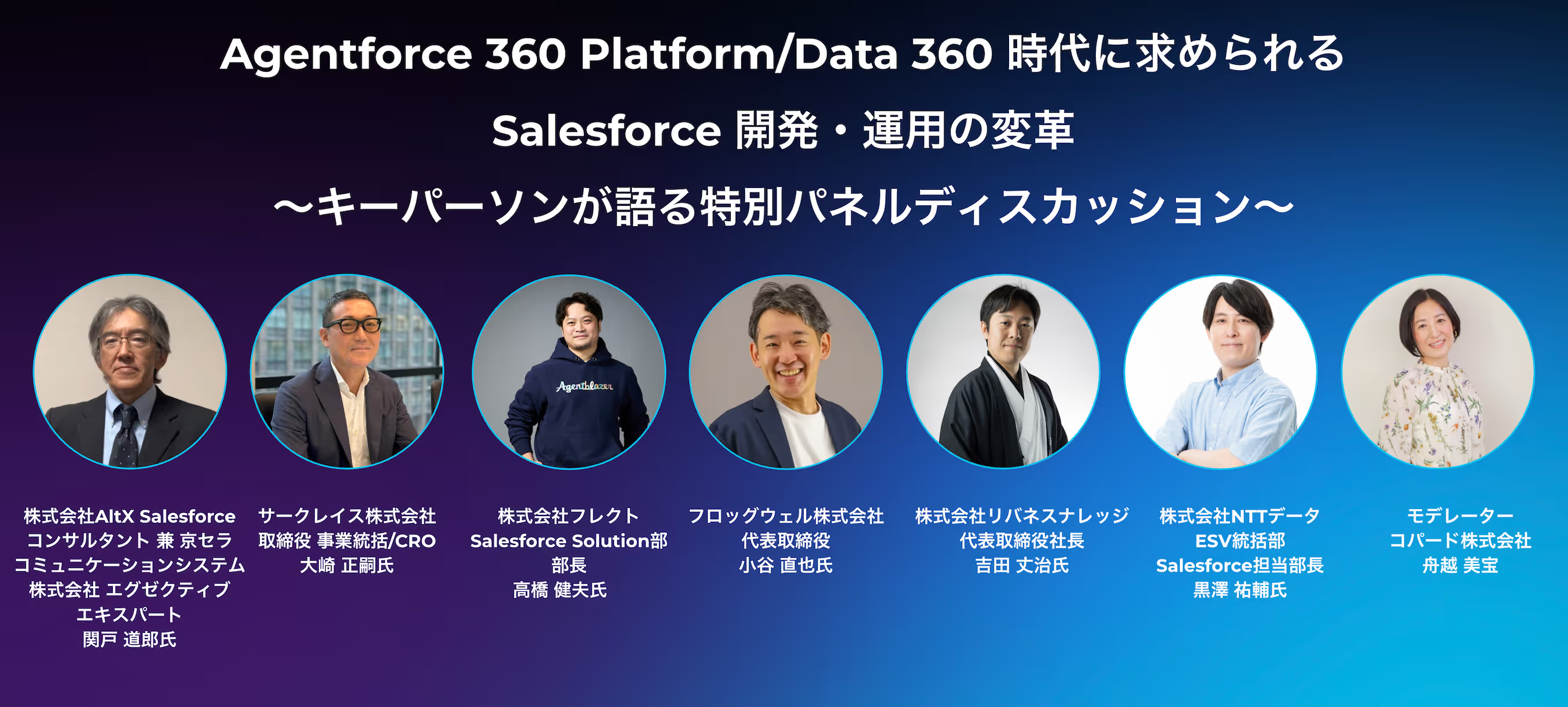
コパード、AIと協働する未来に向けてパートナー6社とDreamforceでパネルディスカッション初開催!
Copado、Salesforce 2025 Partner Innovation Awardを受賞
Copado CI/CD & Robotic Testing Now TX-RAMP Certified for Texas Government
なぜテストが形骸化するのか? - Salesforce開発現場で「テストはやっている」のに、本番障害が減らない理由
Org Intelligence:なぜ「コンテキスト」がSalesforce DevOpsツールにおいてこれほど重要なのか?
「人ではなくAIに聞ける時代へ ― Salesforce環境を理解するCopado AI Org Intelligence」
Salesforceプロジェクトの“隠れコスト”とは?〜DevOps活用で毎月100時間を削減した実践例〜
コパード、セールスフォースの環境をエンドツーエンドで可視化する「組織インテリジェンス」をリリース
パイプラインの可視性が Salesforce DevOps 変革成功の鍵である理由
AIが変える意思決定 - スピードと精度は両立できるのか?
属人運用の限界が経営を止める〜今こそ始めるSalesforce DevOps〜
Salesforceにおけるユーザー受入テストの進め方:課題、ベストプラクティス、および戦略
Navigating Salesforce Data Cloud: DevOps Challenges and Solutions for Salesforce Developers
独自にSalesforce DevOpsソリューションを構築する際の見えざるコスト
CPQ and Revenue Cloud Deployment: A DevOps Approach
Salesforce DevOpsを支えるAI活用型リリース戦略
コパード、サンブリッジパートナーズとの提携により日本での事業を拡大
AIでDevOpsをより簡単に、より高速に
Reimagining Salesforce Development with Copado's AI-Powered Platform
ビジネスアプリケーション向けのDevOps(デブオプス)って何?
セールスフォースエコシステムにおけるDevOpsの卓越性
セールスフォーステストにおけるAI活用のベストプラクティス
6 testing metrics that’ll speed up your Salesforce release velocity (and how to track them)
第4章: 手動テストの概要
セールスフォース向けAI動作テスト
Chapter 3: Testing Fun-damentals
Salesforce Deployment: Avoid Common Pitfalls with AI-Powered Release Management
Exploring DevOps for Different Types of Salesforce Clouds
What’s Special About Testing Salesforce? - Chapter 2
Why Test Salesforce? - Chapter 1
Continuous Integration for Salesforce Development
Comparing Top AI Testing Tools for Salesforce
Avoid Deployment Conflicts with Copado’s Selective Commit Feature: A New Way to Handle Overlapping Changes
From Learner to Leader: Journey to Copado Champion of the Year
The Future of Salesforce DevOps: Leveraging AI for Efficient Conflict Management
How To Sync Salesforce Environments | Copado
Copado and Wipro Team Up to Transform Salesforce DevOps
DevOps Needs for Operations in China: Salesforce on Alibaba Cloud
What is Salesforce Deployment Automation? How to Use Salesforce Automation Tools
From Chaos to Clarity: Managing Salesforce Environment Merges and Consolidations
Future Trends in Salesforce DevOps: What Architects Need to Know
Enhancing Customer Service with CopadoGPT Technology
What is Efficient Low Code Deployment?
Copado Launches Test Copilot to Deliver AI-powered Rapid Test Creation
Cloud-Native Testing Automation: A Comprehensive Guide
Building a Scalable Governance Framework for Sustainable Value
Copado Launches Copado Explorer to Simplify and Streamline Testing on Salesforce
Exploring Top Cloud Automation Testing Tools
Master Salesforce DevOps with Copado Robotic Testing
Exploratory Testing vs. Automated Testing: Finding the Right Balance
A Guide to Salesforce Source Control | Copado
A Guide to DevOps Branching Strategies
Family Time vs. Mobile App Release Days: Can Test Automation Help Us Have Both?
How to Resolve Salesforce Merge Conflicts | Copado
Copado Expands Beta Access to CopadoGPT for All Customers, Revolutionizing SaaS DevOps with AI
Is Mobile Test Automation Unnecessarily Hard? A Guide to Simplify Mobile Test Automation
From Silos to Streamlined Development: Tarun’s Tale of DevOps Success
Simplified Scaling: 10 Ways to Grow Your Salesforce Development Practice
What is Salesforce Incident Management?
What Is Automated Salesforce Testing? Choosing the Right Automation Tool for Salesforce
Copado Appoints Seasoned Sales Executive Bob Grewal to Chief Revenue Officer
Business Benefits of DevOps: A Guide
Copado Brings Generative AI to Its DevOps Platform to Improve Software Development for Enterprise SaaS
Copado Celebrates 10 Years of DevOps for Enterprise SaaS Solutions
Celebrating 10 Years of Copado: A Decade of DevOps Evolution and Growth
5 Reasons Why Copado = Less Divorces for Developers
What is DevOps? Build a Successful DevOps Ecosystem with Copado’s Best Practices
Scaling App Development While Meeting Security Standards
5 Data Deploy Features You Don’t Want to Miss
How to Elevate Customer Experiences with Automated Testing
Top 5 Reasons I Choose Copado for Salesforce Development
Getting Started With Value Stream Maps
Copado and nCino Partner to Provide Proven DevOps Tools for Financial Institutions
Unlocking Success with Copado: Mission-Critical Tools for Developers
How Automated Testing Enables DevOps Efficiency
Go back to resources
There is no previous posts
Go back to resources
There is no next posts

Explore more about

Agentforce
Articles
May 8, 2026
Salesforce Source Format vs Metadata Format
Articles
May 7, 2026
Get Started with Agentforce in Salesforce
Articles
May 5, 2026
What Is Agentforce Salesforce?
Articles
April 27, 2026
AIエージェント時代のシステム戦略 ~ROIを最大化するIT部門の再設計~【イベントレポート CIO Round Table 2026】

AIを有効活用しDevOpsを加速

より速くリリースし、リスクを排除し、仕事を楽しんでください。
Try Copado Devops.

リソース

Explore our DevOps resource library. Level up your Salesforce DevOps skills today.

今後のイベントと
オンラインセミナー

電子書籍とホワイトペーパー

サポートとドキュメンテーション

デモライブラリ